
04/09/96 - 11:20 AM ET - Click reload often for latest version
Each week, USA TODAY will feature a leading college coach providing tips on improving hockey skills. This week's guest coach is Bill Wilkinson of Western Michigan University.
by Coach Bill Wilkinson, Western Michigan University
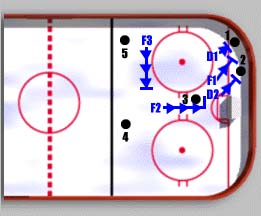
Double-down defense can be used without giving up any strength in the defensive zone. It must be employed with speed and strength. The key to making the double-down defense concept successful is to out-number the opponent in the defensive zone at the puck area, thus creating an imbalance of force.
In the defensive zone, your first player (first defenseman, D-1 on diagram) must attack the puck carrier (No. 1) with force to create physical contact, trying to tie up that player as quickly as possible. In most defensive zone coverages, the second defensive player (first forward, F-1) would be responsible for the second attacker. However, in the double-down defense, the second defensive player (F-1) is responsible to assist the initial defender. This creates the double-down effect.
Then, the third defender (second defenseman, D-2) must be responsible for the second offensive player (No. 2) by staying on the defensive side of the puck and player he or she is covering.
The weakside defensive forward (second forward, F-2) must cover down in front of the net area where the opponent's third forward (No. 3) should be; F-2 becomes responsible for this player.
The strongside forward (third forward, F-3) must play off the boards between the two opponents defensemen (No. 4 and 5) high in the zone. This forces the puck to be passed in front of F-3, not behind or below to an opponent's defenseman.
Bill Wilkinson is in his 14th season as the coach of the Western Michigan University program. Coming into the year he had a 259-231-36 career and WMU record, ranking him 41st among NCAA all-time Division I hockey coaches for victories and 14th among active coaches. As the Broncos' coach, Wilkinson has guided the 1985-86 and 1992-93 squads to NCAA regional play. The 1985-86 team won the CCHA Championship tile and had a 32-12 overall record, one of the best in the nation that season. Wilkinson has twice been selected the CCHA coach of the year, in 1984 and 1986. He was one of the six finalists for the Spencer Penrose national coach of the year in 1994. Prior to taking over the WMU program, Wilkinson was an assistant coach at Bowling Green State University (1980-82), University of North Dakota (1979) and at his alma mater St. Lawrence University (1971-78). A native of Goderich, Ont., Wilkinson graduated from SLU with a bachelor's degree in physical education in 1970 and earned his master's degree in education there in 1976.
